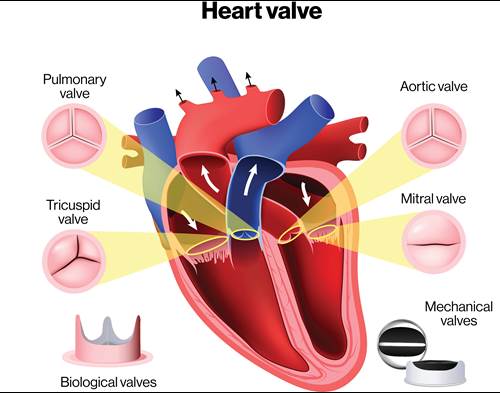
Valvular heart disease is when any valve in the heart has damage. The normal heart has four chambers, along with blood vessels entering or leaving these chambers, and four valves. Valves open and close to regulate blood flow through the heart’s chambers. Diseased/damaged valves may not be able to fully open or close during heart contraction/relaxation. Valves may become “narrowed” meaning they don’t fully open; this is called stenosis. Blood is unable to easily pass through. When a valve is “leaky” it does not fully close. During regurgitation, blood leaks back into the chamber that it came from and enough blood is not pushed forward through the heart. If sufficiently severe, these conditions at the different valves can increase the workload on the heart, and eventually cause it to “fail.” People generally develop different symptoms/signs, which commonly include congestive heart failure. Valve problems generally require mechanical repair (such as transcatheter or open surgical repair or replacement).
Associations/Risk Factors:
CAD with CHF
Hypertension/High blood pressure
Rheumatic fever
Drug use
Senescence (deterioration with age)
Congenital anomalies (inborn or birth defects of the heart muscle/chambers, arteries, valves or electrical system)
 Back-Education
 (706)850 3795
  Patient Portal Login